
Quick Answer:
The Ontario Home Renovation Savings Program gives Ottawa homeowners rebates of up to $5,000 for homes heated primarily with Enbridge natural gas, or up to $10,000 for homes heated with electricity, and it is currently funded to November 30, 2026. Siding itself is not rebate-eligible. The exterior wall insulation, air sealing and house wrap installed underneath it are, which makes a re-side the single best opportunity most Ottawa homeowners get to claim it.
Key Takeaways
- The program is confirmed funded to November 30, 2026, and program terms state it can be modified or end at any time.
- Maximum rebates are up to $5,000 for homes primarily heated with Enbridge natural gas and up to $10,000 for electrically heated homes on the Ontario grid.
- Those maximums include up to $600 toward the cost of the home energy assessment itself.
- There are two paths: single upgrades with no energy assessment, and bundled upgrades requiring a pre- and post-retrofit assessment by a Registered Energy Advisor.
- New siding on its own does not qualify. Exterior wall insulation and air sealing do.
- Because the walls are already open, re-siding is the only cost-effective moment to add exterior insulation.
- The program applies whether you heat with electricity, natural gas, oil, propane or wood.
- The federal Canada Greener Homes Grant and Loan have closed. This provincial program is now the main rebate route in Ontario.
What Is the Ontario Home Renovation Savings Program?
The Home Renovation Savings Program is a provincial rebate program delivered jointly by Enbridge Gas and Save on Energy, with support from the Government of Ontario. It replaced the Home Efficiency Rebate Plus (HER+) program, which closed to new applicants in February 2024.
It pays homeowners to make their homes more energy efficient, insulation, air sealing, windows and doors, heat pumps, heat pump water heaters, smart thermostats, and solar and battery storage. Critically for Ottawa homeowners, it is not restricted to natural gas customers. You can access it whether your home runs on electricity, natural gas, oil, propane or wood.
The program was originally scheduled to end November 30, 2025. It has since been extended through November 30, 2026. The official program terms state it can be modified or ended at any time, and previous programs have closed abruptly so treating the deadline as firm is the sensible approach.
How Much Can Ottawa Homeowners Claim From the Home Renovation Savings Program?
The ceiling depends on how your home is heated:
| Your primary heating source | Maximum rebate | Notes |
| Enbridge natural gas | Up to $5,000 | Most common in Ottawa’s urban and suburban housing stock |
| Electricity (on the Ontario grid) | Up to $10,000 | Higher ceiling reflects the greater savings from electrification |
| Oil, propane or wood | Eligible | Oil-heated homes may also access the Oil to Heat Pump Affordability Program |
Maximum rebate amounts include up to $600 toward the home energy assessment. Confirm current values at homerenovationsavings.ca before booking work, amounts change.
In practice, most homeowners land somewhere between $1,500 and $7,500 depending on which upgrades they choose. Insulation measures across a whole home can reach roughly $7,700 on their own, and there is a standalone attic insulation path worth up to $1,000 that skips the energy assessment entirely. BetterHomesOttawa maintains a useful Ottawa-specific summary of the current amounts.
The Two Ontario Renovation Rebate Paths, Explained
Path One: Single Upgrades With No Energy Assessment
You complete one qualifying upgrade and claim a rebate for it. No pre- or post-work energy assessment is required, which makes this the faster and simpler route. Upgrades on this path include cold climate air source heat pumps, ground source heat pumps, solar and battery storage, and smart thermostats. Attic insulation also has its own standalone path.
Path Two: Bundled Upgrades That Require an Energy Assessment
You start with a home energy assessment by a Registered Energy Advisor, complete at least two qualifying upgrades, then have a final assessment done by the same advisor. Your advisor submits the rebate application on your behalf and the rebate is paid to you by cheque.
This is the path that matters for exterior work. Insulation, air sealing, and windows and doors all sit on the bundled path, and those are exactly the measures that become accessible when your siding comes off.
The sequencing is not negotiable. The pre-retrofit assessment must happen before the work starts. Homeowners who begin work first and apply afterwards forfeit the rebate entirely, and this is the single most common way people lose it.
Does New Siding Qualify for the Ontario Home Renovation Savings Program?
No, and it is worth being direct about that, because plenty of contractor websites imply otherwise.
Cladding is not an energy-efficiency measure in the program’s terms. Replacing vinyl with fibre cement siding, or Cape Cod with Celect, does not on its own trigger a rebate no matter how much better the new product performs.
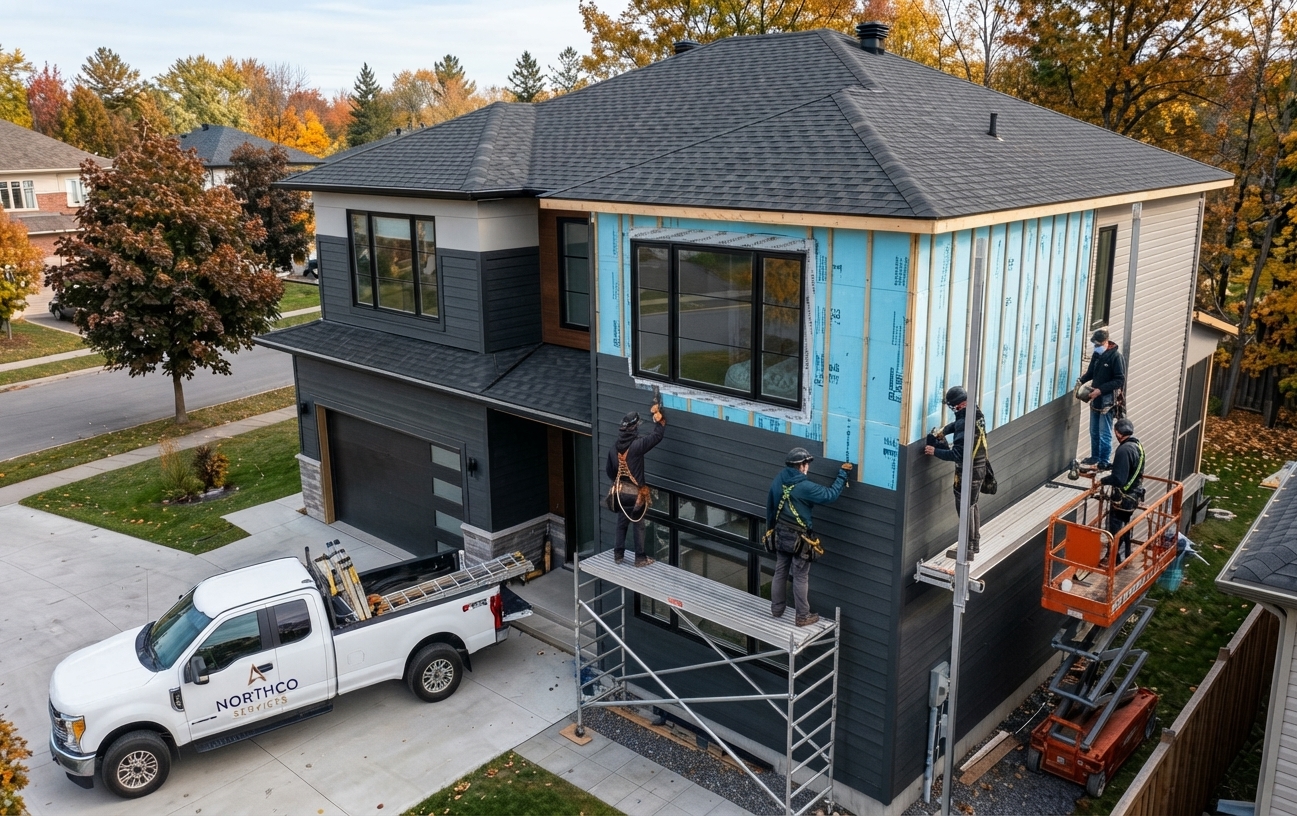
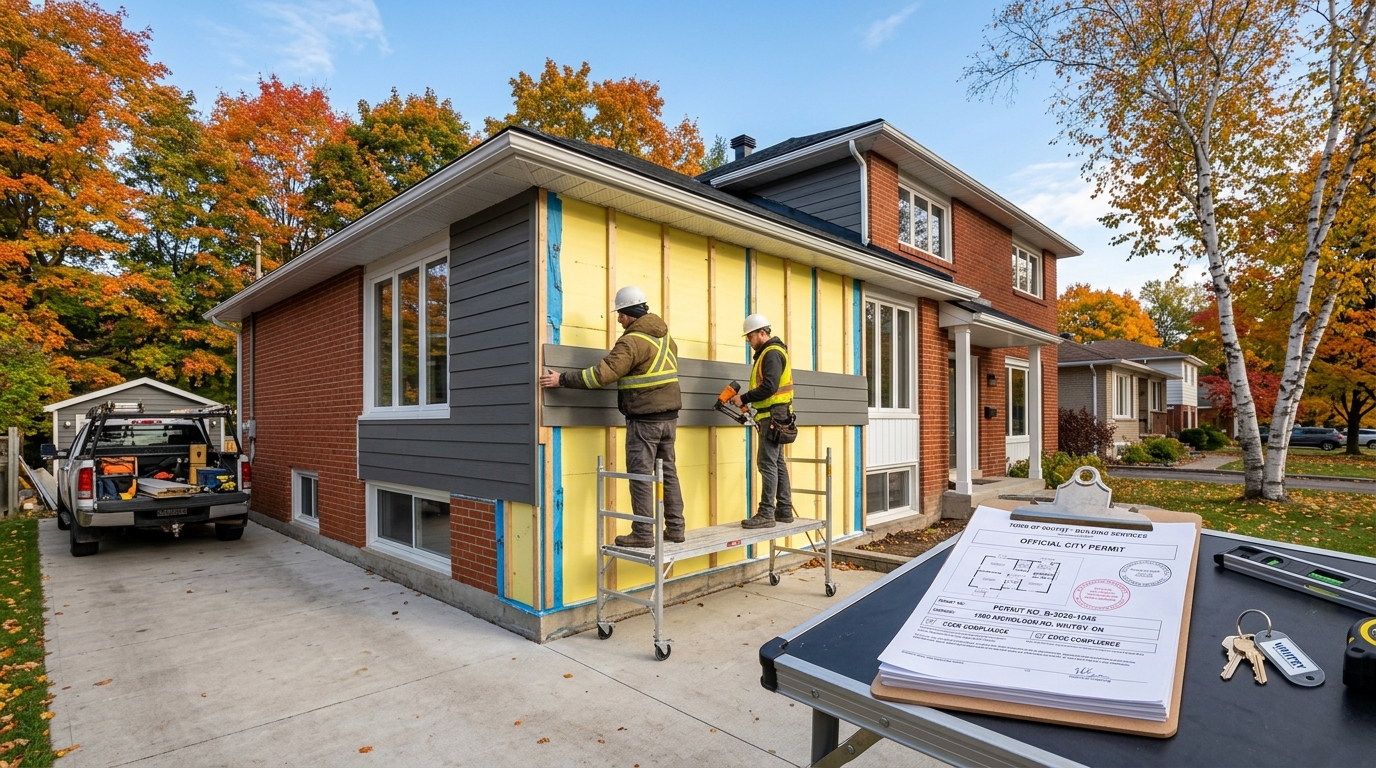
What does qualify is what goes on behind it. Exterior wall insulation and air sealing are both eligible measures under the bundled path. When your old siding is stripped off, your wall assembly is exposed for the first time in decades, and that is the moment continuous exterior insulation and a properly detailed exterior wrap can be installed.
Why Re-Siding Is the Only Cost-Effective Time to Add Exterior Wall Insulation
Adding exterior wall insulation as a standalone project means paying a crew to remove your siding, install the insulation, and reinstall or replace the siding. You pay the removal and reinstallation labour purely to get access.
If you are already replacing your siding, that access cost is already in the budget. The incremental cost of adding continuous exterior insulation and upgrading the air barrier at that point is a fraction of what the same work costs on its own, and it is the portion that qualifies for the rebate. Our guide to long-term savings with energy efficient siding covers how those envelope gains compound over a heating season.
This is why the order of operations matters so much. A homeowner who re-sides in 2026 without touching the wall assembly has not just missed a rebate; they have closed the window on affordable wall insulation for the next thirty to forty years.
| Planning exterior work this season? Book a free exterior assessment and we will tell you what your wall assembly can realistically claim before the November 30 deadline. |
How to Apply for the Ontario Renovation Rebate Without Losing It
The order matters more than anything else on this page:
- Check current program details and rebate amounts at ca before you commit to anything. Amounts and eligible measures change.
- Book your pre-retrofit home energy assessment with a Registered Energy Advisor. Advisors get booked up ahead of a deadline, so build in lead time.
- Get quotes for the work, including the insulation and air sealing scope, not just the siding. Our siding cost guide for Ottawa explains what should and should not appear on that quote.
- Complete at least two qualifying upgrades using qualified contractors, and keep every invoice.
- Book your post-retrofit assessment with the same advisor, within the program’s stated window.
- Your advisor submits the application. The rebate arrives by cheque, typically several weeks after closeout.
One practical note for Ottawa: exterior work has a short season here, and the November 30 deadline falls right at the end of it. A project starting in October is cutting it fine once assessments and weather delays are factored in, though as we explain in our guide to installing siding in an Ottawa winter, cold-season work is not automatically off the table.
Ontario Home Renovation Rebates That Have Closed
The federal picture looks different than it did two years ago. The Canada Greener Homes Grant and the Canada Greener Homes Loan are both closed. A replacement, the Canada Greener Homes Affordability Program, has been in development and is expected to target lower-income households, but Ontario homeowners should not plan around it until it is confirmed and open.
Enbridge’s Home Efficiency Rebate Plus closed to new applicants in February 2024. If you received a quote based on HER+ figures, those numbers no longer apply.
For now, the Home Renovation Savings Program is the main rebate route available to Ontario homeowners for energy-efficiency work, and for anyone already planning siding and exterior wrap in Ottawa, it is money left on the table if the two jobs are not scoped together.
| NorthCo has been building Ottawa’s exteriors since 1993. Get a free quote that scopes your siding and your wall assembly as one project, the only way to make the rebate work for you. |
FAQs
Is the Ontario Home Renovation Savings Program still available in 2026?
Yes, The program has been extended through November 30, 2026. Program terms state it can be modified or ended at any time without notice, so it is worth applying earlier rather than later.
Does replacing my siding qualify for a rebate in Ontario?
No, Siding and cladding are not eligible measures on their own. However, exterior wall insulation and air sealing installed while the siding is off are eligible under the bundled upgrade path, which is why the two jobs are best done together.
Do I need an energy assessment to get the rebate?
It depends on the path. Single upgrades such as heat pumps, smart thermostats and standalone attic insulation do not require an assessment. Bundled upgrades, including wall insulation, air sealing, and windows and doors, require both a pre-retrofit and a post-retrofit assessment by the same Registered Energy Advisor.
Can I get the rebate if I heat with oil or propane?
Yes, The program applies regardless of whether you heat with electricity, natural gas, oil, propane or wood. Homes heated with oil may also qualify for the separate Oil to Heat Pump Affordability Program.
What happens if I start the work before applying?
You will almost certainly lose the rebate. On the bundled path, the pre-retrofit assessment must be completed before any work begins. Starting first is the most common reason applications are rejected.
How long does it take to receive the rebate?
After your advisor submits the closeout documentation, rebates are typically paid within roughly four to six weeks, though processing times vary with application volume.