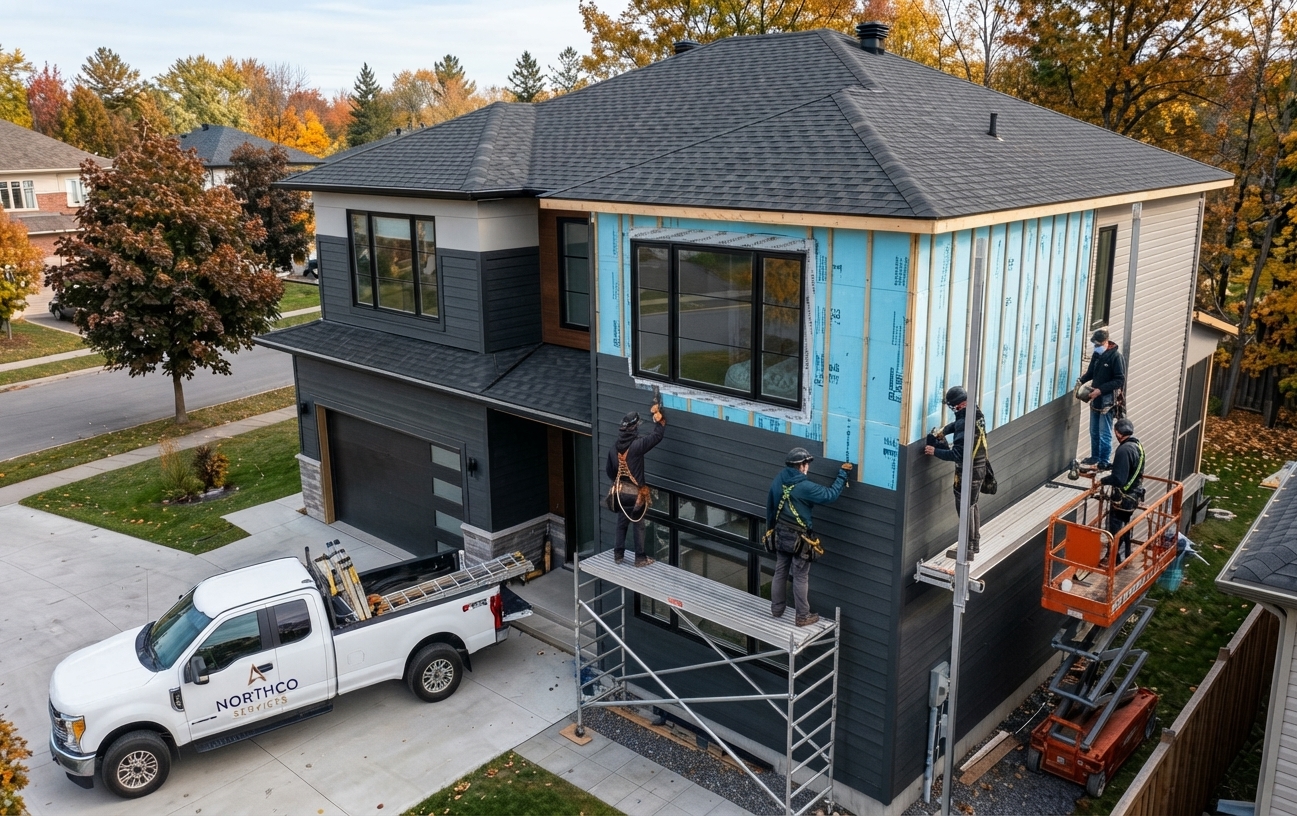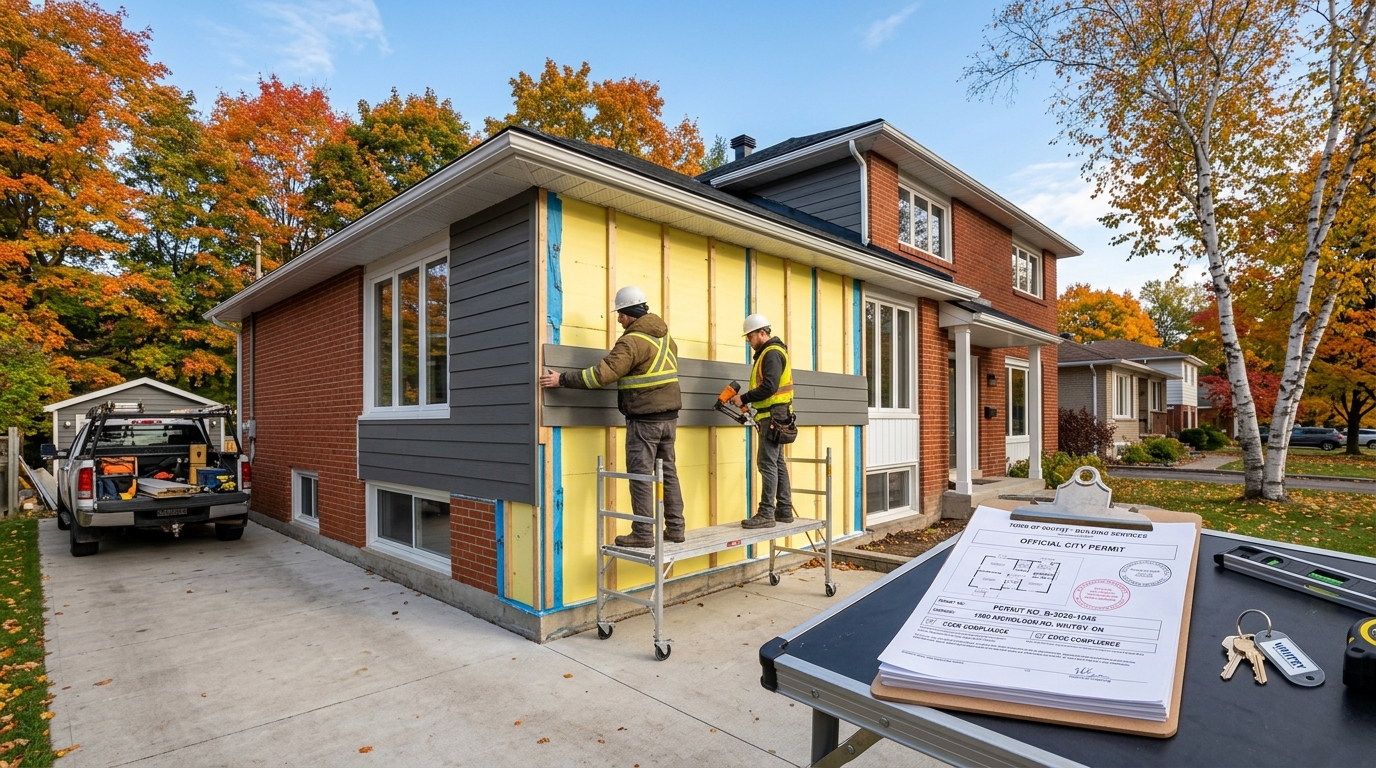

Quick Answer: Yes, siding can be installed in Ottawa through the winter, but the material matters a great deal. Vinyl becomes brittle in deep cold and requires wider expansion gaps and careful handling; fibre cement, engineered wood and metal tolerate low temperatures considerably better. Most crews treat roughly -15°C as the practical working limit, below which cutting quality, fastener performance and crew safety all degrade.
Key Takeaways
- Winter siding installation is possible in Ottawa and is done routinely, it is not automatically a bad idea.
- Vinyl is the most cold-sensitive common material. It contracts significantly and becomes brittle, so it cracks more easily during handling and nailing.
- Expansion gaps must be set differently in winter. Vinyl installed tight in January will buckle in July.
- Fibre cement, engineered wood and metal handle cold far better, though sealant curing still needs managing.
- Sealants and caulking have minimum application temperatures, this is where most winter installations actually go wrong.
- Always follow the manufacturer’s published installation instructions. Ignoring them can void the product warranty.
- Off-season scheduling often means better crew availability and shorter lead times than the May-to-October rush.
- Emergency repairs after storm or ice damage should never wait for spring.
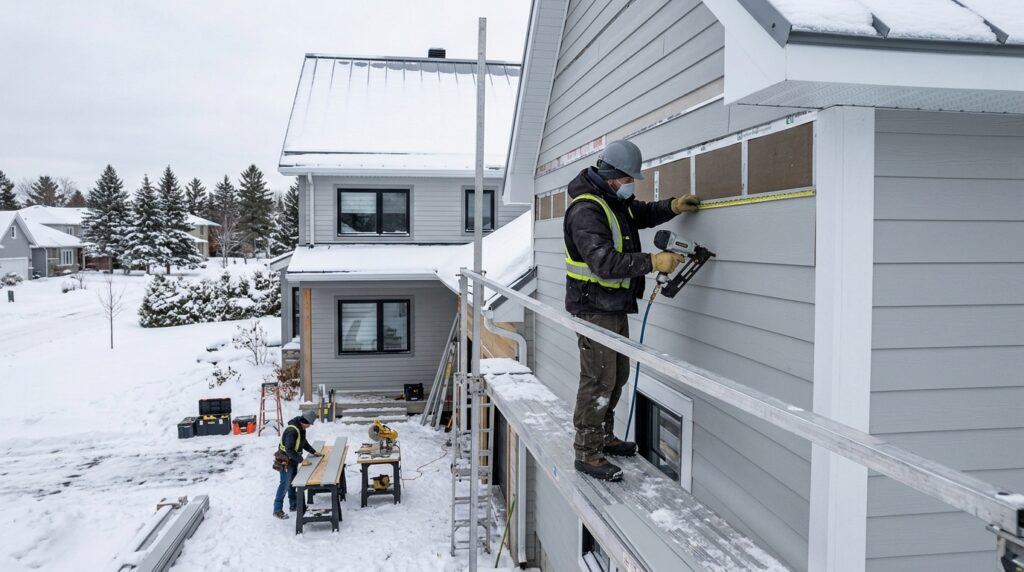
Can You Install Siding in Winter? It Depends on the Material
There is no single temperature at which siding installation becomes impossible. What changes in the cold is how each material behaves, and the gap between the siding materials we install in Ottawa is much wider than most homeowners expect.
| Material | Cold weather behaviour | Winter install verdict |
| Vinyl | Contracts noticeably and becomes brittle. Prone to cracking when cut, handled or nailed in deep cold. | Possible with experienced crews and adjusted gaps |
| Cape Cod / aluminum | Handles cold well. Metal is dimensionally stable at low temperatures. | Generally fine |
| Fibre cement | Very stable across temperature extremes. Cutting dust behaves differently in cold, dry air. | Generally fine |
| Engineered wood | Stable. Manufacturer sealant and finishing requirements need attention. | Generally fine |
| Metal / Longboard | Excellent dimensional stability. Handling in cold requires care to avoid oil-canning. | Generally fine |
Manufacturer installation instructions always govern. Installing below a specified minimum temperature can void the product warranty regardless of workmanship.
If you are still choosing between products, our comparison of siding choices for wind and moisture resistance in Ottawa and our guide to which siding needs the least maintenance are the two most useful starting points.
What Goes Wrong With Winter Siding Installation in Ontario
Expansion Gaps Set for the Wrong Season
This is the most consequential winter installation error, and it does not show up until summer.
Siding expands and contracts with temperature. Vinyl siding in particular moves a great deal, across Ottawa’s roughly 65-degree annual swing, a long run changes length visibly. Installed in July it is already near its longest, so gaps are set accordingly. Installed in January it is at its shortest, and the installer must deliberately leave wider gaps for the expansion coming in six months. We covered the underlying behaviour in how vinyl siding holds up during Ottawa’s harsh winters.
A crew that installs winter vinyl at summer tolerances produces a wall that buckles, waves and pulls at the fasteners the following July. The homeowner sees the problem in summer and blames the product.
Sealants and Caulking in Cold Weather
Most sealants have a minimum application temperature, and many cure poorly or not at all below it. Around windows, doors and penetrations, precisely where water gets in, this matters more than the cladding itself.
This is a solvable problem. Cold-weather-rated sealants exist, and warming products before application helps. But it requires a crew that has planned for it. It also matters for the exterior wrap and air barrier behind the cladding, where a poorly cured seal is invisible once the siding goes back on.
Cutting, Fastening and Handling Cold Siding
Cold vinyl chips rather than cuts cleanly. Fasteners driven into brittle material can crack it. Panels carried across an icy site get dropped. None of these are exotic risks — they are ordinary handling issues made worse by temperature, and they are managed with slower, more careful work, which is part of why winter timelines stretch.
Daylight and Winter Site Conditions in Ottawa
Ottawa loses a great deal of working daylight in December and January. Snow has to be cleared, ladders need safe footing, and material staging is harder. A job that takes eight days in September may take twelve in January, and that shows up in the quote, as we explain in our Ottawa siding cost breakdown.
When Winter Siding Installation Makes Sense
Several situations make waiting the wrong call:
- Storm or ice damage has breached the envelope. Water getting into a wall assembly does progressive damage, this is not a spring problem. The City of Ottawa publishes guidance on building repairs after extreme weather, including when a permit is required for storm-related work.
- The existing siding has already failed and is admitting moisture. Same logic, the wall is deteriorating while you wait.
- You are working to a hard deadline, such as a property sale or the Ontario Home Renovation Savings Program cut-off on November 30, 2026.
- You want spring availability and are willing to book off-season to secure a crew and a schedule that suits you.
In the first two cases especially, a partial repair to stabilise the envelope through winter, followed by full replacement in spring, is often the sensible middle path. A good contractor will offer that rather than pushing a full winter installation you did not need.
| Storm damage or failing siding right now? Book an exterior assessment, we will tell you honestly whether it needs doing now or can safely wait for spring. |
When to Wait for Spring Siding Installation
Equally, waiting is the right answer when the project is purely cosmetic, when your chosen material is vinyl and the forecast is sitting well below -15°C, when the scope includes extensive sealant work around many openings, or when you simply are not in a hurry.
There is no prize for re-siding in February if the wall behind is sound. The building envelope does not care whether it looks dated.
What to Ask an Ottawa Contractor About Winter Siding Work
If you are considering a cold-season installation, the questions that actually matter are: what does the manufacturer specify as the minimum installation temperature, and will you work below it? How are you adjusting expansion gaps for the season? What sealants are you using and what is their rated application temperature? Does installing now affect the product warranty? And what happens to the schedule in a two-week cold snap?
A contractor who answers those five specifically has done winter work before. Vagueness on any of them is the signal to wait. Our top 10 questions to ask your siding contractor in Ottawa covers the year-round version of this conversation, and there is a real case for choosing a local siding contractor when the work depends this heavily on understanding the local climate.
| NorthCo installs through Ottawa winters and will tell you when not to. Get a free quote with the seasonal trade-offs spelled out before you commit. |
FAQs
Can siding be installed in winter in Ottawa?
Yes. Siding is installed year-round in Ottawa, though the material matters. Fibre cement, engineered wood and metal handle cold well. Vinyl is more cold-sensitive and requires experienced handling and adjusted expansion gaps.
What is the lowest temperature for installing vinyl siding?
There is no universal figure, the manufacturer’s published installation instructions govern, and installing outside them can void the warranty. As a practical matter, many crews treat roughly -15°C as the working limit, below which cutting quality, fastener performance and safety all decline.
Does vinyl siding crack in cold weather?
Vinyl becomes more brittle as temperature drops, so it is more prone to cracking during cutting, handling and nailing. Properly installed vinyl performs well through Ottawa winters; the risk is concentrated in the installation itself, not in the finished wall.
Is siding cheaper to install in winter?
Not necessarily cheaper, but availability is usually better. Ottawa’s exterior season concentrates demand between May and October, so booking off-season often means shorter lead times and more scheduling flexibility.
Should I wait until spring to replace damaged siding?
Not if the damage is letting water into the wall assembly. Moisture in a wall causes progressive damage through winter. A temporary repair to stabilise the envelope, followed by full replacement in spring, is often the best approach.
Does installing siding in winter void the warranty?
It can, if installation falls outside the manufacturer’s specified temperature range or installation instructions. Always confirm this in writing with your contractor before work begins.